

📌 Reframing Frantz Fanon
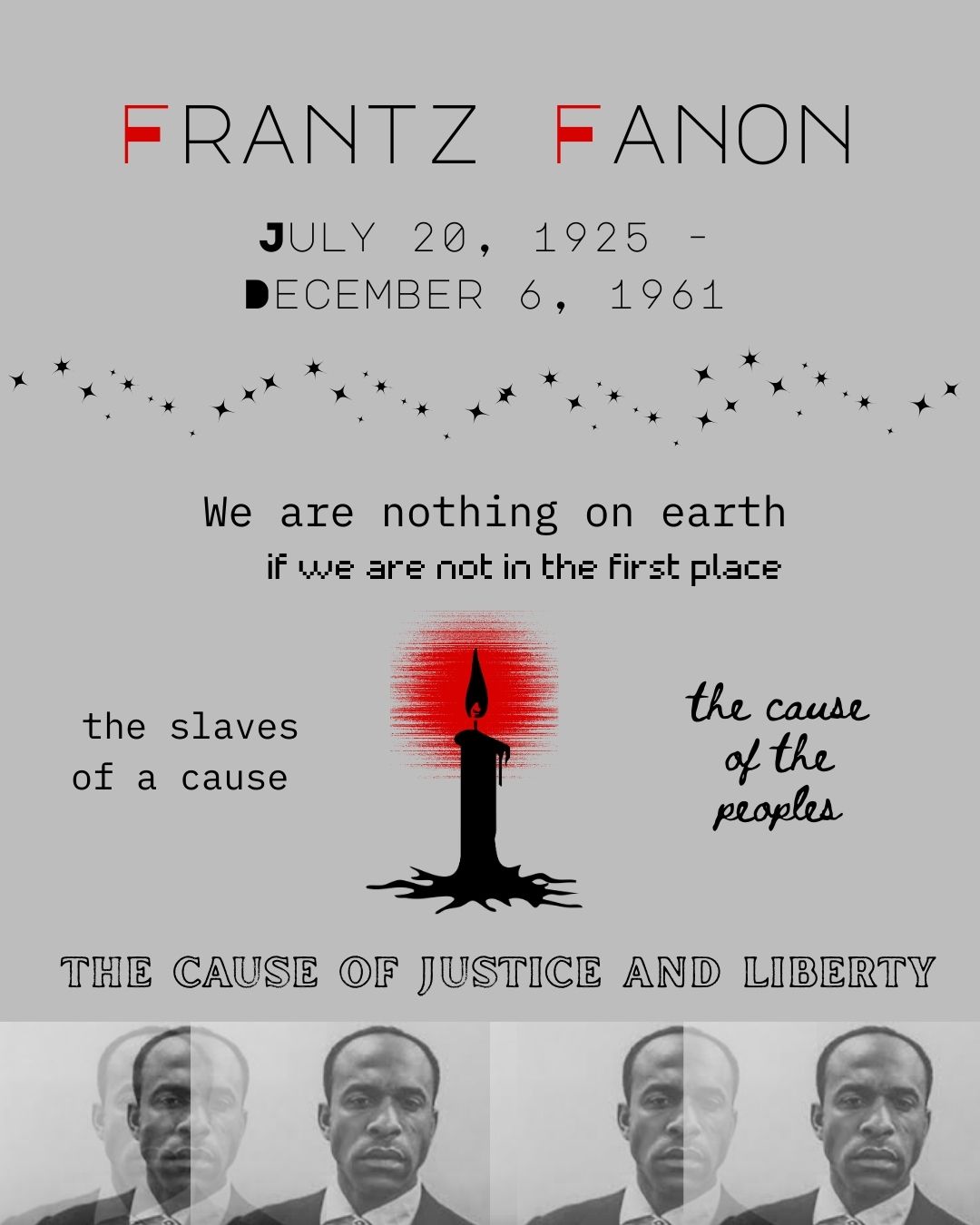
Frantz Fanon is a fixture in my thinking, a source of profound inspiration. He fascinates me, and I’m certainly not alone. It’s safe to say some version of Fanon is being canonized by the Western intellectual establishment. Which one? is the question. But more importantly, as Ato Sekyi-Otu observes in the opening lines of Fanon’s Dialectic of Experience (1996), the “rhythms of [Fanon’s posthumous] fame and decline…defies…all semblance of sequential order.” In other words, over the past sixty-four years, Fanon has drifted in and out of the spotlight. The pattern of this ebb and flow has, on some level, mirrored the shifting political and cultural conditions under which we turn to him for meaning.
Take Sekyi-Otu's account. The “first prolific wave of Fanon Studies” stretches from his death on December 6, 1961 until the publication of Irene Gendzier’s Frantz Fanon: A Critical Study (1973). This “steady stream” of “journalistic assessments, scholarly papers, and full length books” was followed by a period of “relative neglect and intermittent attention” across the 1970s. But the turning tides of the 1980s brought with them a “veritable renaissance.” For Sekyi-Otu, key works of this “remarkable revival” include L. Adele Jinadu, Fanon: In Search of the African Revolution (1980, 1986); Jock McCulloch, Black Soul, White Artifact: Fanon's Clinical Psychology and Social Theory (1983); Hussein Abdilahi Bulhan, Frantz Fanon and the Psychology of Oppression (1985); Patrick Taylor, The Narrative of Liberation: Perspectives on Afro-Caribbean Literature, Popular Culture and Politics (1989); and Edward Said's "magisterial" Culture and Imperialism (1993).
Crucially, however, Sekyi-Otu attributes this high point to the “collective enthusiasm” of “so-called colonial discourse theorists and post colonial critics” for whom Fanon serves as a “precocious if sometimes perfidious ancestor.” This family of thinking is represented in the work of Homi K. Bhabha. Bhabha, of course, goes on to write the foreword to the 2004 Grove Press edition of The Wretched of the Earth (titled “Framing Fanon”), lending him, to Sekyi-Otu's point, interpretive influence over both text and field.
Sekyi-Otu uses this sketch to contextualize his self-described departure from the “postmodernist commitments” of the 1980s — the “overwhelming concentration” on the “psychodynamics of otherness and marginality.” (Recall he is writing in the early 1990s.) Fanon’s Dialectic of Experience, Sekyi-Otu clarifies, is motivated by a different set of concerns:
I revisit Fanon's work as an African who, while trained, employed, and residing in the West, is exercised first and foremost by the disasters of the postindependence experience in Africa. I reread Fanon in light of that experience and the hopes and fears it inspires as South Africa - no doubt a unique society, yet an emblematic instance, in Fanon's eyes, of the colonial condition - reinvents itself, reinvents itself with Nelson Mandela already delivering stern remonstrances, in ominously Pan-African fashion, against “the forces of anarchy and chaos,” against all those benighted enough to think that injustice, despite or rather because of the official abrogation of apartheid, is alive and well.
Sekyi-Otu’s "African- situationist” re-reading offers a necessary, refreshing, and I might argue, under-appreciated set of insights. For my own work, it’s his insistence we turn to the social treason of post independence rule (which I’ve briefly written and talked about) and the invitation to read Fanon’s work as a dialectical dramatic narrative. Does that all not describe what we find unfolding at the heart of Fanon’s declaration, "the last shall be first," that is, the truth of the Black Revolution?
Needless to say, Sekyi-Otu inspires me. On the anniversary of Fanon’s death, he gives me reason to step back and, with something like an autonomously framed eye, survey the contemporary and popular work on Fanon to understand exactly what it is we want from him. How to describe the emerging analytics, desires, and agendas motivating our particular turn? If Autonomous Frame Studio is committed to political education, we are committed to the cultural conditions of that education. Over the years, I’ve found myself specifically entranced by how Fanon appears in and on film. From documentaries to thrillers, his presence supercharges if not overwhelms the medium, creating something else entirely. So for this week, I share something a little different. The following list of films are ones I've seen or long to see in order to write about them collectively (hi editors!). This list is not representative, exhaustive, or endorsed. It is simply framed. For myself, I see a written piece carved out of this watch list, a piece that might involve the relationship between film and life after death. I’m not sure. Consider this a shared prompt to think deeply about the im/possibility of a “canonized” Fanon and the question of culture — a question he himself took up with such intensity and focus. As you settle in to curate your winter watches, I wonder if you’ll join me in prioritizing some of the pieces below.
We begin with The Criterion Channel’s “Frantz Fanon at 100” — a list of films inspired by the anti-colonial revolutionary. Criterion offers a serious point of departure for such a visual assignment as the one we’ve taken on. They write, “[Fanon’s] radical assertion of anticolonial consciousness and call to resistance can be felt in landmark cinematic bombshells by Ousmane Sembène (BLACK GIRL), Gillo Pontecorvo (THE BATTLE OF ALGIERS), and Sarah Maldoror (SAMBIZANGA), while more recent filmmakers like Isaac Julien (FRANTZ FANON: BLACK SKIN, WHITE MASK) and Göran Olsson (CONCERNING VIOLENCE) have perpetuated Fanon’s legacy through experimental documentaries that illuminate his life and ideas through powerfully evocative imagery.”
Next up is Luce (2019), a personal favorite to think about. Luce is an unusual thriller that tries to sow the specter of Fanon into the quiet racial terror of suburban America. This movie caught me off guard. For its limits, I’m intrigued by how Luce has stayed with me. The core delirium (who is Luce?) is at turns heavy-handed/perhaps mishandled and gripping/thought-provoking . I find myself asking — how does one really “teach” Fanon in a formal educational setting? In what ways do we expect students to be transformed?
Finally, I wrap up with two recent films working the circuits: Abdenour Zahzah‘s True Chronicles Of The Blida Joinville Psychiatric Hospital In The Last Century, When Dr Frantz Fanon Was Head Of The Fifth Ward Between 1953 and 1956 (2024) and Jean-Claude Barny's Fanon (2024/2025). I have yet to see either! I will note that there’s a growing interest in Fanon as a revolutionary psychiatrist and the sociotherapeutic dimension of his work. There is also a wonderful body of scholarship running parallel to this turn. I’ve found myself bouncing between Nigel Gibson and Roberto Beneduce’s Frantz Fanon, Psychiatry, and Politics and David Marriott’s Whither Fanon? while I also await Lara Sheehi’s From the Clinic to the Streets: Psychoanalysis for Revolutionary Futures, which I know to be deeply informed by a Fanonian view. It’s with this backdrop I approach the visualization of Fanon’s psychiatric practice. How might we read all of this together?
If and as you watch, I’d love to hear from you. Write me a note, send me an email, find me online as f_bottt!
yours in intellectual struggle,
f
📌 The List
Frantz Fanon at 100 (2025) x curated by The Criterion Channel https://www.criterionchannel.com/frantz-fanon-at-100
Luce (2019) x Julius Onah https://m.imdb.com/title/tt7616148/
True Chronicles Of The Blida Joinville Psychiatric Hospital In The Last Century, When Dr Frantz Fanon Was Head Of The Fifth Ward Between 1953 And 1956 (2024) x Abdenour Zahzah
Fanon (2024/2025) x Jean-Claude Barny
Frantz Fanon, Psychiatry
and Politics x Nigel Gibson & Roberto Beneduce
Whither Fanon? Studies in the Blackness of Being x David Marriott
From the Clinic to the Streets: Psychoanalysis for Revolutionary Futures x Lara Sheehi
📌Veillance Plane - Reading & Media List
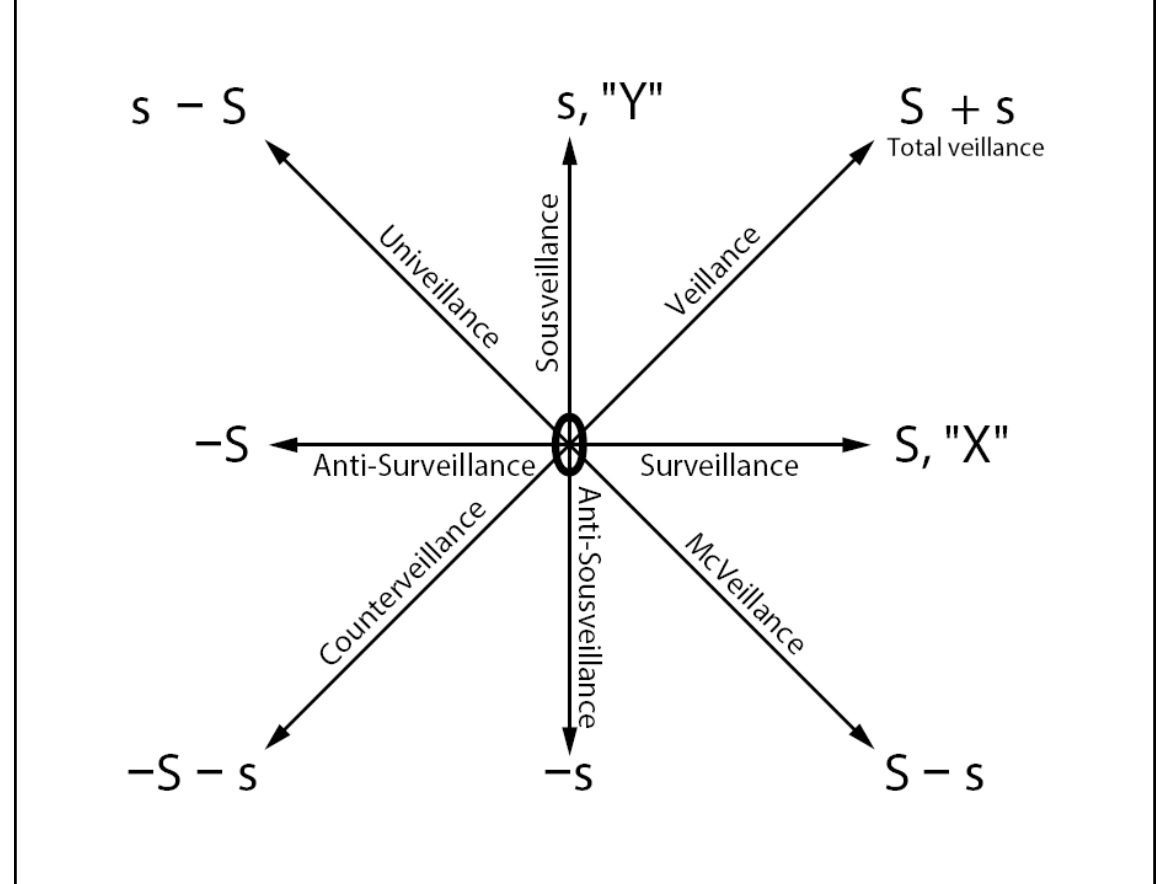
Veillance Plane is an annotated list of current/popular readings + media curated with an autonomously framed eye and intended to deepen our observational powers. A Veillance Plane is a conceptual model of surveillance directionalities developed by Steve Mann (above). In her groundbreaking work Dark Matters, Simone Browne works dark sousveillance into the plane. She writes,
I plot dark sousveillance as an imaginative place from which to mobilize a critique of racializing surveillance, a critique that takes form in antisurveillance, countersurveillance, and other freedom practices…
Following Browne, this biweekly reading + media list focuses on enhancing our sense of position and capacity within the political and cultural landscape of our times.
I thank my former student Jan (condensedsoymilk on Instagram!) for the language of an autonomously framed eye.