
This museum experience was first published on Tumblr in 2018.
This morning I went to the Albuquerque Museum which is primarily an art museum and had one of the most enjoyable museum experiences of my life in one particular exhibit. The majority of the pictures in this exhibit were of excavations of automobiles. The photographer is Patrick Nagatani, a Japanese American born in 1945. His extended family’s hometown was Hiroshima and he was born (in America) a few days after the bomb was dropped. His parents spent at least some of their World War II years in a determent camp.
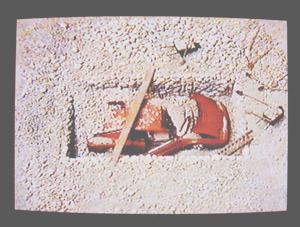
Here is the story as it unfolds in the museum exhibition. An archaeologist from Japan, Ryoichi, was sent to Montana on assignment to document a Native American ceremony where a car was burned and then buried. The natives told Ryoichi that a similar ceremony was happening near the Mexico border and so he traveled and observed. Then, on the way back stopped to offer aid when a car in front of him had an accident. A shaman who was part of the ritual was dying and offered him a satchel full of maps where coordinates were mapped out of burial sites.
Three months later, the archaeologist could not get this out of his mind. The locations on the map had importance -cultural and societal- and vehicles were buried there? He built a team of archaeologists to excavate the cars in secret. It took 14 years. When they were done the archaeologist and all the materials from the digs mysteriously disappeared. So the only remaining evidence are the photographs of Patrick Nagatani. As you might surmise the vehicles were not buried at locations such as Chaco Canyon, Peru, near the pyramids in modern day but by the ancient ones in ancient time. What did it mean? Were automobiles truly part of ancient indigenous cultures? Chaco Canyon does appear to have a road network when looked at in aerial photography. Or is time not linear but more fluid than we think? The journal entries written by the archaeologist was fascinating. At the end the archaeologists involved in the project were unsure if they were grave robbers or scientists and of what their discovery meant of the truth.
And, of course, it is a work of fiction. Nagatani’s middle name is Ryoichi. Each photograph of a car “excavation” was carefully staged.
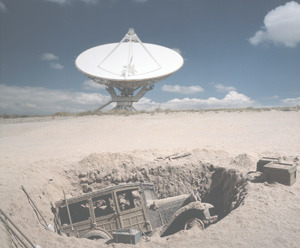
Such devotion, detail and imagination went into each work of art, the singular photograph. Imagine the additional details to create the entire story and multiple photographs and journal entries. The exhibit was quite unique and the fictional story especially effective when told in a museum exhibition.
Nagatani was a UNM professor who died in October 2017. His website talks about the “hoax”.
“The maps, the site plans, the careful record of successive layers of habitation - photographed, these elements of archaeological evidence insist on their truthfulness as scientific discourse and photographic record. I layer the elements we accept as scientific record to construct an alternate reading of the past, and alternative stratigraphy of truth and illusion. With this project I hope to challenge us to examine the ways in which photography creates, recreates, or supports a particular history. I want to consider what we accept as evidence and why. I hope to orchestrate our understanding of the archaeologists' quest and suggest that it may have meaning for our own approach to the unknown.
This project expresses my interest in testing the realities that can exist within the realm of photography and physical documentation. I am interested in how the photograph is also recognized less as a window on the "real," and far more as a malleable picture space - constructed and contrived for the purpose of examining representation rather than reality. I am interested in the potential of photography to tell a story. “
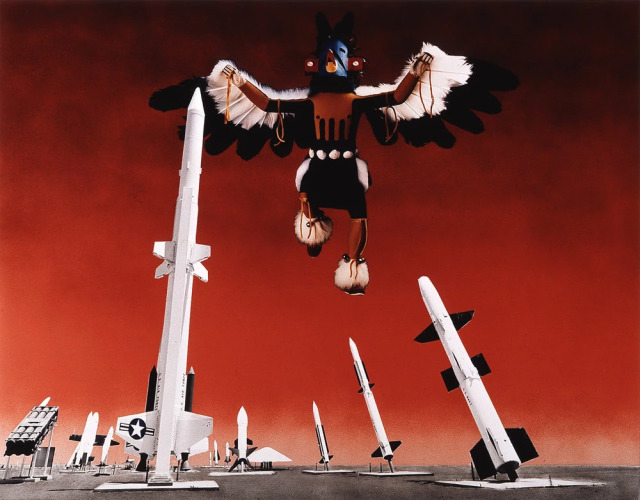
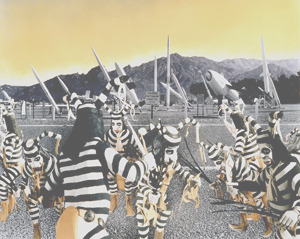
So much about this seems to me to include the intersections of New Mexico- The Native American mysticism, the alien “ancient ones”, the route 66 automobile enthusiasm. There are so many layers of political commentary to unravel. Will our end come due to our worship of the automobile? What is the value and threats of archaeological digs? What is our nature to time outside of the time in which we inhabit?
I have never heard about this artist before today, but this is not his most well known work. I will end with some pictures of his other work. His website is at: https://www.patricknagatani.com/